

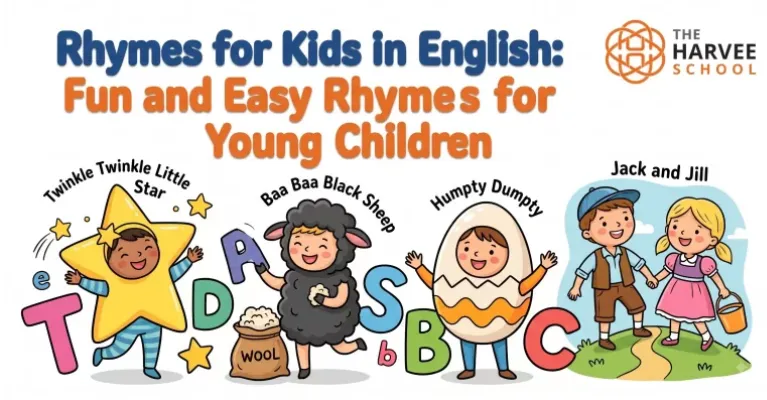
Rhymes for Kids in English: Fun and Easy Rhymes for Young Children

By The Harvee School
Children love music, sounds and repetition. A simple rhyme can make them smile, move their hands, clap, and even learn new words. This is why rhymes for kids in English are a popular part of early learning at home and in preschool classrooms.
Rhymes are not only fun to listen to. They can also help children improve their language, memory, pronunciation and listening skills. When children sing the same rhyme many times, they slowly become familiar with new words and sounds.
For young children, especially those between three and five years old, learning through songs and rhymes can feel more like play than studying. This makes rhymes for kids of 3 to 5 years a simple and enjoyable way to support early learning.
Whether you are a parent looking for activities at home or a teacher planning a classroom activity, these rhymes for kids can bring more fun into a child’s day.
Why Are Rhymes Important for Children?
Rhymes are a simple way to introduce children to language. The repeated words, sounds and actions make it easier for young children to remember what they hear.
Some benefits of rhymes for kids in English include:
- Improving listening skills
- Introducing new words
- Supporting pronunciation
- Building memory
- Encouraging speaking
- Developing rhythm and coordination
- Improving attention
- Making learning enjoyable
- Encouraging children to participate
- Building confidence
For example, when children repeat a short rhyme again and again, they begin to recognise familiar words. They may also start singing along without needing help from an adult.
Rhymes for Kids of 3 to 5 Years
Children between three and five years are at an important stage of language development. They are learning how to communicate, ask questions, remember words and express their thoughts.
This is why rhymes for kids of 3 to 5 years should be short, simple and easy to repeat.
Parents and teachers can choose rhymes that include:
- Simple words
- Repeated phrases
- Fun sounds
- Animals
- Numbers
- Colours
- Family members
- Everyday activities
- Simple actions
For example, a rhyme about a cat can help children learn the word “cat”, while a rhyme about numbers can make counting more interesting.
Popular Nursery Rhymes for Kids
Traditional nursery rhymes for kids have been enjoyed by generations of children. Many of them are short and have simple words, making them easy for young children to remember.
Here are some popular choices:
1. Good Morning, Little Star
Good morning, little star,
Wake up, wake up where you are.
Wash your face and brush your teeth,
Put your little shoes beneath.
Eat your breakfast, smile so bright,
Start your day with joy and light!
2. Wash, Wash, Wash Your Hands
Wash, wash, wash your hands,
Wash them nice and clean.
Before you eat your tasty food,
Keep those little fingers clean.
Front and back and in between,
Wash away the dirt we see.
Wash, wash, wash your hands,
Healthy hands for you and me!
3. One, Two, Three
One little bird up in a tree,
Two little bees buzzing by me.
Three little flowers growing bright,
Four little stars shining at night.
Five little fingers wave hello,
Count them once, then count them slow!
4. My Little Red Ball
My little red ball goes bounce, bounce, bounce,
I roll it around and jump up and down.
I catch it softly, then let it go,
Watch my little red ball roll!
Bounce to the left,
Bounce to the right,
Play with my ball
From morning till night!
5. The Happy Little Cat
A little cat went meow, meow, meow,
It saw a bird sitting on a bough.
It wagged its tail and looked up high,
Then watched the bird fly through the sky.
Meow, meow, little cat,
Where are you going after that?
Come and play, come and run,
Let’s have a happy day of fun!
6. Rain, Rain, Little Rain
Little rain comes falling down,
Making puddles all around.
Tap, tap, tap upon the ground,
Happy raindrops make a sound.
Put your boots on, come outside,
Jump in puddles side by side.
Rainy days can still be fun,
Cloudy skies hide the golden sun!
7. Clean-Up Time
Clean up, clean up, one, two, three,
Put your toys where they should be.
Books on shelves and blocks away,
Now our room is clean today!
Clean-up time can be fun,
We can work together, everyone.
When our little job is done,
We can smile and play some more!
8. Five Little Fingers
Five little fingers on my hand,
They help me work and help me stand.
They clap together, one, two, three,
They wave a friendly hello to thee!
Five little fingers, strong and bright,
Help me write and hold things tight.
I can count them every day,
Five little fingers wave hooray!
9. My Happy School
I pack my bag and wear my shoes,
I get ready for school with a happy mood.
Books and pencils tucked inside,
My little bag is by my side.
I learn, I read, I sing and play,
I meet my friends throughout the day.
School is where I laugh and grow,
Learning new things wherever I go!
10. Bedtime Moon
The little moon is shining bright,
The stars are twinkling in the night.
Close your eyes and rest your head,
It’s time to go to sleepy bed.
Dream of flowers, birds and trees,
Dream of butterflies and gentle bees.
Good night, little one, sleep tight,
See you in the morning light!
The actions make the rhyme more engaging and help children connect words with movement.
Fun Rhymes for Learning Numbers
Rhymes can also make early maths easier. Counting rhymes allow children to practise numbers while singing.
Parents can use songs and rhymes to help children:
- Count from 1 to 10
- Recognise numbers
- Understand simple sequences
- Practise counting objects
- Remember number names
For example, children can count their toys while singing a simple counting rhyme. This turns a normal activity into a learning game.
Using rhymes for kids during early learning can make numbers feel less difficult and more enjoyable.
Rhymes That Teach Colours and Shapes
Children can also learn basic colours and shapes through songs.
A teacher might create a simple rhyme about a red ball, a blue sky or a yellow sun. Children can then look around the classroom and find objects that match the colour mentioned in the rhyme.
Similarly, a rhyme about circles, squares and triangles can help children become familiar with basic shapes.
These activities are especially useful in preschool classrooms because children can learn while singing, moving and looking at real objects around them.
How Rhymes Help Children Learn English
For children who are learning English, rhymes can be particularly useful. Repetition gives children many chances to hear the same words.
Rhymes for kids in English can help children become more comfortable with common English sounds and expressions.
For example, children may learn simple words such as:
- Sun
- Moon
- Star
- Cat
- Dog
- Ball
- Tree
- Bird
- Book
- House
When these words appear in a song or rhyme, children may remember them more easily because they are connected to rhythm and repetition.
This can be helpful for children learning English at home, in preschool or at school.
How Parents Can Use Rhymes at Home
Parents do not need special teaching materials to enjoy rhymes with children. A few minutes each day can be enough to make the activity enjoyable.
Here are some simple ideas:
Sing Together
Choose one rhyme and sing it together. Do not worry about having a perfect singing voice. Children usually enjoy joining in with their parents.
Add Actions
Use simple hand and body movements. For example, children can clap, jump, wave, point or pretend to be an animal.
Actions can make nursery rhymes for kids more exciting and easier to remember.
Use Toys
If the rhyme is about animals, bring out toy animals. If it is about a boat, children can use a toy boat while singing.
This gives children something visual to connect with the words.
Repeat Favourite Rhymes
Children often want to hear the same rhyme many times. Repetition is actually useful for learning.
Let children choose their favourite rhyme and sing it regularly.
Ask Simple Questions
After the rhyme, ask easy questions such as:
- Who was in the rhyme?
- What happened?
- What colour was mentioned?
- How many objects did we hear about?
- Which part did you like?
This can encourage children to speak and remember what they heard.
Make Rhymes Part of the Daily Routine
Rhymes do not have to be limited to classroom time. They can be included in different parts of the day.
For example:
Morning: Sing a greeting rhyme.
Playtime: Use an action rhyme.
Learning time: Use counting or alphabet rhymes.
Outdoor time: Sing a rhyme about animals, nature or movement.
Bedtime: Choose a calm and familiar rhyme.
This makes learning feel natural instead of like a separate task.
Simple Rhyme Activities for Preschool Children
Teachers and parents can turn rhymes into small activities.
Rhyme and Draw
After singing a rhyme, ask children to draw something they heard about. If the rhyme is about a star, they can draw stars in the sky.
Rhyme and Act
Give each child an action to perform while the rhyme is being sung. This can help shy children participate.
Find the Word
Choose one simple word from the rhyme and ask children to find an object that matches it.
Rhyme and Count
Use a counting rhyme and ask children to count toys, blocks or other classroom objects.
Rhyme With Puppets
Simple hand puppets can make storytelling and singing more exciting. Children can also make their own paper puppets.
These activities can work well in preschools and early learning classrooms across India.
Choosing the Right Rhymes for Young Children
Not every rhyme needs to be complicated. For young children, simple is often better.
When choosing rhymes for kids of 3 to 5 years, look for rhymes that:
- Have short lines
- Use familiar words
- Include repetition
- Have simple actions
- Are easy to pronounce
- Match the child’s age
- Encourage participation
It is also helpful to choose rhymes based on children’s interests. Some children may love animals, while others may enjoy numbers, vehicles, nature or family-themed rhymes.
Final Thoughts
Rhymes for kids in English can make early learning simple, fun and memorable. They give children an enjoyable way to listen, speak, move and learn new words.
From traditional nursery rhymes for kids to simple counting and action songs, there are many options for parents and teachers. The best rhyme is often one that children enjoy repeating.
If you are looking for rhymes for kids, start with short and familiar ones. For younger children, choose rhymes for kids of 3 to 5 years that use simple words and fun actions.
With a little singing, movement and repetition, rhymes can become a happy part of a child’s everyday learning journey.