

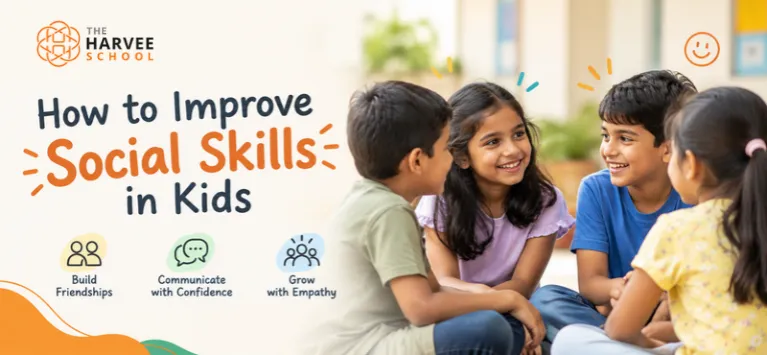
How to Improve Social Skills in Kids

By The Harvee School
Social skills help children talk to others, make friends, share, listen, and work as a team. These skills are important at home, at school, and in everyday life.
Some children easily talk to others, while some may be shy or take more time to feel comfortable. Social skills can be learned with regular practice and support from parents and teachers.
If you are wondering how to improve social skills in kids, simple activities at home and school can make a big difference.
What Are Social Skills?
Social skills are the skills children use when they interact with other people. They include:
- Talking and listening
- Sharing with others
- Taking turns
- Making friends
- Asking for help
- Following simple rules
- Understanding feelings
- Working in a group
- Solving small problems
- Being kind and respectful
Children learn these skills slowly as they grow and spend time with other people.
1. Talk to Your Child Every Day
Regular conversations can help children become better at talking and expressing their thoughts.
Ask your child about their day, school, friends, and activities. Try questions such as:
- What did you enjoy today?
- What did you learn at school?
- Who did you play with?
- What made you happy today?
Listen carefully when your child talks. Let them finish before you respond.
This simple habit can help children feel more comfortable sharing their thoughts.
2. Teach Your Child to Listen
Good communication is not just about talking. Children also need to learn how to listen.
Teach your child to:
- Listen when someone is speaking
- Wait for their turn
- Avoid interrupting
- Pay attention to what others are saying
You can practise this during family conversations or while reading stories together.
3. Encourage Group Play
Playing with other children is a simple way to build social skills.
Games and activities can teach children how to share, take turns, follow rules, and work together.
You can encourage activities such as:
- Board games
- Puzzles
- Team sports
- Drawing together
- Building blocks
- Group art activities
- Simple team games
Children learn a lot about working with others while playing.
4. Teach Sharing and Taking Turns
Young children may find it difficult to share their toys or wait for their turn. This is normal.
Parents can teach these habits through simple activities.
For example, if two children want the same toy, encourage them to take turns. Explain that everyone will get a chance to play.
When your child shares or waits patiently, praise them. Simple encouragement can help them repeat the behaviour.
5. Help Children Understand Feelings
Children need to understand their own feelings and the feelings of others.
Teach simple words such as:
- Happy
- Sad
- Angry
- Worried
- Excited
- Scared
- Disappointed
Ask your child how they feel and why they feel that way.
You can also ask, “How do you think your friend feels?”
Stories and cartoons can also help children understand different emotions.
6. Use Role-Play
Role-play is a fun way to help children practise social situations.
For example, you can pretend that your child is meeting a new friend. Show them how to say hello and start a conversation.
You can also practise situations such as:
- Asking someone to play
- Asking for help
- Saying thank you
- Saying sorry
- Sharing a toy
- Joining a group
- Handling a disagreement
This can make children feel more prepared when they face similar situations in real life.
7. Teach Children How to Handle Arguments
Children may sometimes argue with their friends or siblings. This is a normal part of growing up.
Teach your child to talk about the problem instead of shouting or hurting others.
Simple phrases can help:
“Can we take turns?”
“I don’t like that.”
“Let’s play together.”
“Can we find another way?”
Children can slowly learn how to solve small problems on their own.
8. Give Children Time With Other Kids
Children need regular opportunities to interact with other children.
Playdates, sports, school activities, clubs, and group games can help children practise social skills.
Parents do not have to guide every conversation. Give children some space to talk and play on their own.
If they face a small problem, give them a chance to find a solution before stepping in.
9. Be a Good Example
Children learn a lot by watching adults.
Show your child how to:
- Listen to others
- Speak politely
- Say thank you
- Say sorry
- Share
- Help others
- Stay calm during disagreements
When children see these behaviours at home, they are more likely to use them with their friends and classmates.
10. Encourage Social Activities at School
School is an important place for children to build social skills. Children spend time with classmates, teachers, and other members of the school community.
Group activities, classroom discussions, games, clubs, events, and team projects can give children many chances to talk, share ideas, and work with others.
At The Harvee School, children get opportunities to take part in activities that encourage communication, teamwork, participation, and learning with others. These experiences can help children become more comfortable working and interacting with their classmates.
How to Teach Kids Social Skills
Teaching kids social skills starts with simple activities at home and school. Parents can help children learn how to talk politely, listen to others, share, and make friends.
Here are a few easy ways to teach kids social skills:
- Show good behaviour: Use polite words, listen carefully, and treat others with kindness. Children often learn by watching adults.
- Practise everyday conversations: Teach children how to say hello, ask questions, and start a conversation with others.
- Encourage sharing: Let children play games that involve sharing toys and taking turns.
- Teach them to express feelings: Help children use words to explain when they feel happy, sad, angry, or upset.
- Give them chances to play in groups: Group games and school activities help children learn teamwork and cooperation.
- Praise their efforts: Appreciate your child when they share, help a friend, or speak politely.
Be patient while teaching these skills. Every child learns at a different pace. With regular practice and encouragement, children can become more confident when talking to others and making friends.
When Should Parents Seek Extra Help?
Every child develops social skills at their own pace. Some children are very talkative, while others are quiet or take longer to feel comfortable around new people.
However, if your child regularly finds it very difficult to communicate, make friends, join activities, or interact with others, talk to their teacher or paediatrician.
They can help you understand your child’s needs and suggest the right support if needed.
Final Thoughts
Social skills are not learned in one day. Children develop them through regular practice and everyday experiences.
Talking with your child, encouraging group play, teaching sharing and taking turns, discussing feelings, and giving children opportunities to interact with others can help build better social skills.
With support from parents and teachers, children can slowly become more confident, friendly, and comfortable around others.