

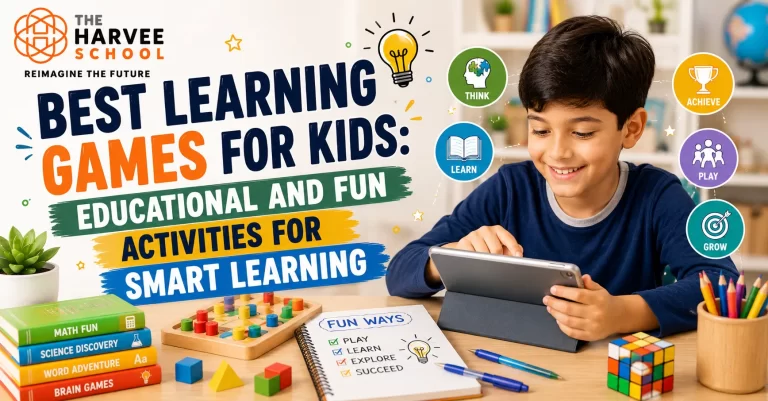
Best Learning Games for Kids: Educational and Fun Activities for Smart Learning

By The Harvee School
Learning becomes much more exciting when it feels like play. Children naturally enjoy games because they are fun, interactive, and engaging. The good news is that many games can also help kids build important skills such as reading, math, problem-solving, creativity, and critical thinking.
Today, parents have access to a wide range of learning apps for kids, online resources, and interactive activities that make education enjoyable. Whether your child is learning at home, during school holidays, or after school hours, the right games can turn everyday playtime into a valuable learning experience.
In this guide, we’ll explore some of the best learning games for kids, along with digital tools and offline activities that encourage learning while keeping children entertained.
Why Learning Games Are Important for Kids
Children learn best when they are actively involved in the learning process. Games create an environment where kids can practice new skills without feeling pressured.
Some benefits of educational games for kids include:
- Improved problem-solving abilities
- Better memory and concentration
- Enhanced reading and math skills
- Increased creativity
- Better hand-eye coordination
- Stronger communication and teamwork skills
- Greater confidence in learning
The best part is that children often don’t realize they’re learning because they’re having fun at the same time.
Best Learning Games for Kids
1. Word Building Games
Word games help children improve vocabulary, spelling, and reading comprehension.
Popular activities include:
- Scrabble Junior
- Word searches
- Crossword puzzles
- Letter matching games
- Sight word challenges
These types of kids learning games help strengthen language skills while encouraging critical thinking.
2. Math Board Games
Math doesn’t have to be boring. Many games help children practice numbers and calculations in a fun way.
Examples include:
- Monopoly
- Math Bingo
- Number puzzles
- Dice games
- Counting challenges
These educational games for kids make mathematical concepts easier to understand through hands-on learning.
3. Memory Matching Games
Memory games improve concentration and cognitive development.
Children can:
- Match picture cards
- Match words and meanings
- Match animals and habitats
- Match countries and flags
Simple memory games are excellent games for kids at home because they require very little equipment and can be played with family members.
4. Science Experiment Challenges
Science-based activities help children explore how the world works.
Fun ideas include:
- Baking soda volcanoes
- Growing plants from seeds
- Making slime
- Building paper bridges
- Creating simple circuits
These activities combine play with discovery, making them some of the most effective kids learning games available.
5. Puzzle Games
Puzzles encourage logical thinking and patience.
Popular options include:
- Jigsaw puzzles
- Maze puzzles
- Sudoku for kids
- Shape puzzles
- Logic challenges
Puzzles help children develop problem-solving skills that support academic learning.
Best Learning Apps for Kids
Technology can be a valuable educational tool when used appropriately. Many learning apps for kids provide interactive lessons, quizzes, and games that support school learning.
Some popular categories include:
- Reading apps
- Math learning apps
- Language learning apps
- Science apps
- Coding apps for children
Parents often choose learning apps for kids because they allow children to learn independently while keeping them engaged through interactive activities.
When selecting apps, look for age-appropriate content, educational value, and a balance between learning and entertainment.
Free Learning Websites for Kids
Many families look for educational resources that don’t require a subscription. Fortunately, there are several excellent free learning websites for kids that offer quality educational content.
These websites often include:
- Interactive lessons
- Educational videos
- Printable worksheets
- Reading materials
- Quizzes and games
The advantage of free learning websites for kids is that children can explore different subjects at their own pace while developing new skills.
Parents can also use these platforms to support homework, revision, and enrichment learning.
Fun Learning Games for Kids at Home
Children don’t always need screens to learn. There are many fun learning games for kids that can be played using simple household items.
Treasure Hunt Learning Game
Hide clues around the house and include simple educational questions.
Children can practice:
- Reading
- Problem-solving
- Following directions
- Critical thinking
Alphabet Scavenger Hunt
Ask children to find objects that start with different letters.
For example:
- A for Apple
- B for Book
- C for Chair
This activity improves vocabulary and letter recognition.
Story Building Game
Start a story with one sentence and let each family member add another sentence.
This helps children develop:
- Creativity
- Language skills
- Imagination
- Communication abilities
These are excellent games for kids at home because they are simple, inexpensive, and enjoyable for the whole family.
Educational Games for Different Age Groups
Different ages require different learning approaches.
Ages 4–6
Focus on:
- Alphabet games
- Counting activities
- Color matching
- Shape recognition
- Basic memory games
Ages 7–10
Introduce:
- Word puzzles
- Math challenges
- Science experiments
- Strategy games
- Reading adventures
Ages 11–13
Encourage:
- Coding games
- Logic puzzles
- Educational quizzes
- Research projects
- Advanced board games
Choosing age-appropriate educational games for kids helps ensure children stay challenged without becoming frustrated.
How Learning Apps and Websites Support Education
Many parents combine traditional learning with digital resources.
Quality learning apps for kids can reinforce classroom lessons through interactive exercises and personalized learning paths.
Similarly, free learning websites for kids provide access to educational materials that support school subjects such as:
- Mathematics
- Science
- English
- Social studies
- Coding
- General knowledge
When used in moderation, these tools can enhance a child’s learning experience and make studying more enjoyable.
Tips for Choosing the Best Kids Learning Games
Not all games offer the same educational value.
When selecting kids learning games, consider:
- Age appropriateness
- Educational objectives
- Safety and privacy
- Ease of use
- Engagement level
- Positive reviews
The best games strike a balance between fun and learning.
Children are more likely to stay motivated when they enjoy the activity while still gaining valuable skills.
Creating a Healthy Learning Routine
While games can be highly educational, balance is important.
Parents can encourage learning by:
- Setting screen time limits
- Mixing online and offline activities
- Playing together as a family
- Celebrating learning achievements
- Providing a variety of educational experiences
Combining games for kids at home, educational activities, and real-world experiences helps children develop well-rounded skills.
Final Thoughts
The best learning games for kids are those that make education exciting, engaging, and meaningful. Whether your child enjoys puzzles, word games, science experiments, or digital activities, there are countless ways to turn playtime into learning time.
From interactive learning apps for kids and free learning websites for kids to creative games for kids at home, today’s educational resources offer endless opportunities for growth and discovery. By choosing the right kids learning games and educational games for kids, parents can help children build confidence, strengthen academic skills, and develop a lifelong love of learning.
When learning feels like play, children stay curious, motivated, and eager to explore the world around them.