

9 Benefits of Outdoor Play: Why Every Child Needs Time Outside

By The Harvee School
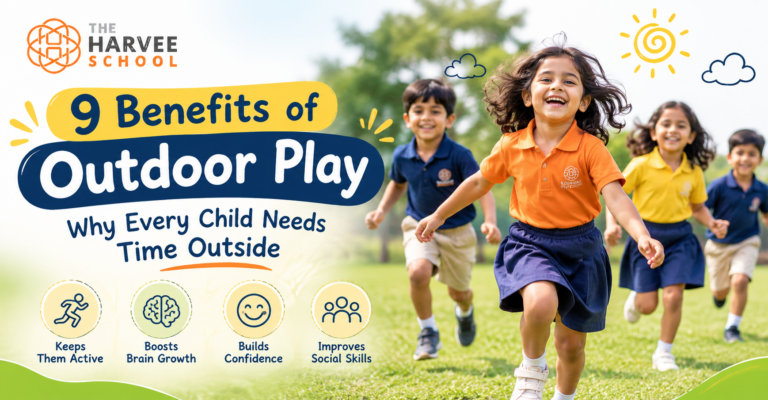
Children love to run, jump, climb, explore and play. Give them an open space, and they will often find many ways to enjoy themselves. But outdoor play is more than just a fun activity. It plays an important role in a child’s physical, social, emotional and mental development.
In today’s world, children spend more time indoors using screens, watching videos or playing with toys. While indoor activities are also important, spending time outdoors gives children different experiences that help them learn about the world around them.
Let’s look at the benefits of outdoor play and why parents should make it a regular part of their child’s daily routine.
1. Supports Physical Development
Running, jumping, climbing, skipping and playing ball help children stay active. These simple activities improve their physical strength and overall fitness.
Outdoor play also helps develop important movement skills, such as:
- Balance and coordination
- Muscle strength
- Flexibility
- Body control
- Hand-eye coordination
For example, when children climb playground equipment or kick a ball, they learn to control their body movements while becoming more physically active.
2. Encourages Creativity and Imagination
Outdoor spaces give children many opportunities to use their imagination. A few stones can become building blocks, fallen leaves can become art materials, and an open space can turn into an imaginary playground.
Children may create their own games, make up stories or explore their surroundings. These activities encourage creative thinking and help them come up with new ideas.
Unlike activities with fixed instructions, outdoor play allows children to explore and decide how they want to play.
3. Helps Children Develop Social Skills
Playing with other children teaches important social skills. During group games and outdoor activities, children learn how to share, take turns, listen and work together.
Sometimes, they may disagree about the rules of a game or who gets to play first. With guidance, they learn to communicate, solve small problems and respect others’ opinions.
These experiences help children become better at interacting with others, both inside and outside the classroom.
4. Builds Confidence and Independence
Every small achievement during outdoor play can help a child feel more confident.
Climbing a small structure, learning to ride a bicycle or completing a simple obstacle course gives children a sense of accomplishment.
Outdoor activities also allow children to make small decisions independently, such as choosing a game or deciding how to complete a task.
When children are given safe opportunities to try things on their own, they gradually become more confident in their abilities.
5. Improves Focus and Learning
Children learn through observation and experience. Outdoor play gives them opportunities to notice different colours, shapes, sounds, textures and movements.
For example, watching insects, collecting leaves or observing how plants grow can make children curious about nature and science.
Spending time outdoors can also give children a break from structured activities. Active play and exploration may help them return to classroom activities feeling refreshed and ready to learn.
6. Supports Emotional Well-Being
Children experience different emotions as they grow. They may feel excited, frustrated, nervous or disappointed during everyday activities.
Outdoor play gives them a healthy way to express their feelings and release energy. Playing freely, exploring nature and spending time with friends can also make children feel relaxed and happy.
Group games teach children how to handle winning and losing, while independent play helps them become comfortable spending time on their own.
7. Encourages a Love for Nature
Outdoor play helps children understand and appreciate the natural world.
Simple activities such as watering plants, watching butterflies, collecting leaves or playing in a garden can introduce children to nature.
They begin to notice how plants grow, how weather changes and how different living things depend on their surroundings.
These early experiences can encourage children to care for the environment as they grow.
8. Develops Problem-Solving Skills
Outdoor activities often present small challenges that encourage children to think.
For example, when building something with blocks, crossing a simple obstacle course or creating a team game, children need to decide what to do next.
They learn to try different approaches, make decisions and find solutions when something does not work.
These experiences develop problem-solving skills that are useful in school and everyday life.
9. Promotes Better Sleep and Healthy Habits
Regular physical activity helps children use their energy throughout the day. Outdoor play can be a simple way to include movement in their daily routine.
Active play, along with a balanced diet and a consistent sleep schedule, supports children’s overall health.
Developing these habits early can encourage children to enjoy physical activity as they grow older.
Fun Outdoor Play Activities for Children
Parents and teachers do not need expensive equipment to make outdoor play enjoyable. Simple activities can offer valuable learning experiences.
Here are a few ideas:
- Nature walks: Encourage children to observe plants, birds, insects and trees.
- Treasure hunts: Ask children to find objects based on colour, shape or size.
- Ball games: Play simple throwing, catching and kicking games.
- Obstacle courses: Use safe play equipment to encourage movement and coordination.
- Gardening: Let children water plants and observe how they grow.
- Group games: Try simple games that teach sharing, teamwork and turn-taking.
Always choose activities that are suitable for the child’s age and provide proper supervision, safe play areas, drinking water and protection from excessive heat.
How Does Outdoor Play Support Early Childhood Education?
Outdoor play is an important part of early childhood learning. It allows children to learn beyond books and classroom activities.
When children explore, experiment and play with others, they develop skills that support their overall growth. They learn to communicate, make decisions, solve problems and understand their surroundings.
At schools that encourage activity-based learning, outdoor experiences can become meaningful opportunities for children to connect what they learn in the classroom with real-life situations.
Outdoor Learning at The Harvee School
At The Harvee School, learning goes beyond traditional classroom activities. The school encourages children to explore, participate and learn through different experiences as part of their Cambridge education from Playgroup to Grade 8.
Outdoor activities and hands-on experiences give children opportunities to develop confidence, teamwork, communication and problem-solving skills.
By combining classroom learning with practical experiences, The Harvee School aims to create an engaging environment where children can discover their interests and develop important life skills.
Final Thoughts
Outdoor play is not just a way to keep children busy. It helps them stay active, build friendships, develop confidence and understand the world around them.
Parents can encourage outdoor play by giving children regular opportunities to run, explore, create and play with others. Even a little time outside each day can become a valuable part of childhood.
A healthy balance of indoor learning and outdoor activities helps children enjoy their early years while developing skills that support them throughout life.