

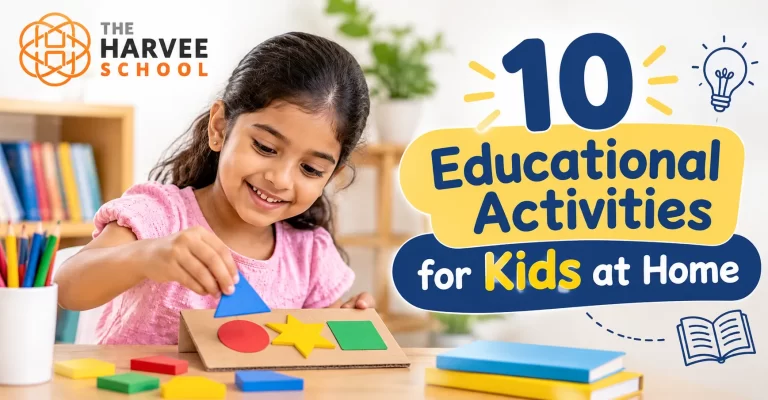
10 Educational Activities for Kids at Home

By The Harvee School
Learning does not have to happen only inside a classroom. Children can learn many useful things through everyday activities at home. Cooking with parents, reading a story, playing puzzles, watering plants and even helping with simple household tasks can become valuable learning experiences.
Educational activities for kids at home help children develop creativity, problem-solving skills, communication and independence. They also give parents an opportunity to spend quality time with their children while encouraging them to explore new interests.
The best part is that most of these activities do not require expensive materials or special equipment. With a little creativity, everyday objects can become useful learning tools.
Why Are Educational Activities Important for Kids at Home?
Children learn in different ways. Some enjoy reading, while others understand concepts better through pictures, movement or hands-on experiences.
Simple learning activities at home can help children:
- Develop curiosity and encourage them to ask questions.
- Improve memory, concentration and problem-solving skills.
- Build creativity and imagination.
- Strengthen communication and language skills.
- Understand basic maths and science concepts.
- Become more confident and independent.
These activities also help children connect what they learn at school with real-life situations.
10 Educational Activities for Kids at Home
Here are ten simple and enjoyable activities that parents can try with children of different age groups.
1. Read Stories Together
Reading is one of the easiest ways to encourage learning at home. Choose colourful picture books, short stories, fairy tales or age-appropriate educational books.
Take turns reading and ask your child questions about the story.
For example:
- Who is your favourite character?
- What do you think will happen next?
- Why did the character make that choice?
- How would you change the ending?
This activity improves vocabulary, listening skills, imagination and reading comprehension. It also helps children become more comfortable expressing their thoughts.
2. Try Simple Science Experiments
Children naturally enjoy discovering how things work. Simple science experiments can turn their curiosity into an exciting learning experience.
Some easy experiments include:
- Floating and sinking: Place different safe household objects in a bowl of water and ask children to predict which ones will float.
- Colour mixing: Mix primary colours using washable paints or food colouring to discover new colours.
- Growing a plant: Place a bean seed in a transparent container with damp cotton and observe its growth over time.
Encourage children to predict what might happen before starting. After the experiment, discuss what they observed and why it happened.
Adult supervision is important, especially when using water, small objects or food colouring.
3. Make Learning Fun with Puzzles and Board Games
Puzzles and board games are excellent educational activities for kids. They encourage children to think, plan and find solutions.
Parents can introduce:
- Jigsaw puzzles for visual recognition and concentration.
- Number puzzles for basic maths practice.
- Word games for vocabulary development.
- Memory cards to improve observation and recall.
- Age-appropriate board games to practise counting and turn-taking.
These games make learning enjoyable while helping children develop patience and logical thinking.
4. Involve Children in Cooking
The kitchen can become a fun learning space. Simple cooking activities introduce children to numbers, measurements, ingredients and following instructions.
For example, ask your child to:
- Count the number of fruits or vegetables.
- Measure ingredients using cups and spoons.
- Identify different colours, shapes and textures.
- Arrange food items in a particular order.
- Follow simple steps to prepare a snack.
Cooking also teaches practical life skills and encourages children to become more independent.
Always choose age-appropriate tasks and supervise children around knives, hot surfaces and electrical appliances.
5. Create an Art and Craft Corner
Art and craft activities allow children to express their ideas and use their imagination.
You can provide paper, crayons, washable paints, cardboard, glue and safe craft materials.
Try activities such as:
- Making animals using paper shapes.
- Creating greeting cards for family members.
- Drawing and colouring favourite objects.
- Making simple paper models.
- Creating collages using old magazines.
These activities help improve hand-eye coordination, fine motor skills, creativity and concentration.
6. Start a Small Home Garden
Gardening is a wonderful way to introduce children to nature and basic science.
Give them a small pot and let them plant easy-to-grow seeds. Encourage them to water the plant, observe its growth and record changes in a small notebook.
Children can learn:
- What plants need to grow.
- How roots, stems and leaves develop.
- Why sunlight and water are important.
- How to care for living things.
- The importance of nature and the environment.
A small gardening activity can teach responsibility while helping children develop an interest in the natural world.
7. Practise Maths Through Everyday Activities
Maths does not always need to involve worksheets or textbooks. Parents can introduce basic mathematical concepts through everyday situations.
For example:
- Count fruits while arranging them in a basket.
- Sort toys according to size, shape or colour.
- Count steps while climbing stairs.
- Compare the weight of two objects.
- Identify numbers while shopping.
- Measure ingredients while cooking.
These simple activities help children understand numbers, patterns, measurements and comparisons in a practical way.
8. Organise a Treasure Hunt
A treasure hunt can turn an ordinary afternoon into an exciting learning activity.
Hide a few safe objects around the house and give children simple clues to find them.
You can make the activity educational by including clues such as:
- Find something that starts with the letter B.
- Look for an object that has three sides.
- Find something that is heavier than a book.
- Search for an object that is blue and round.
This activity encourages reading, observation, logical thinking and problem-solving.
9. Encourage Storytelling and Role-Playing
Give children an opportunity to create their own stories or act out familiar situations.
They can pretend to be teachers, doctors, shopkeepers, chefs or explorers. You can also ask them to create a story using three random objects.
For example, give them a toy, a book and a ball and ask them to connect all three in one story.
Storytelling and role-playing improve language skills, imagination, communication and confidence. They also help children understand different roles and everyday situations.
10. Build Something Using Blocks or Recycled Materials
Building activities encourage children to think creatively and understand basic concepts related to shapes, balance and structures.
Provide building blocks, cardboard boxes, paper rolls or other safe reusable materials.
Ask children to:
- Build a tower using blocks.
- Create a small house using cardboard.
- Design a bridge for toy cars.
- Make different shapes using craft materials.
- Build something based on their own ideas.
These activities introduce early engineering concepts and encourage children to experiment, plan and solve problems.
How to Create a Simple Learning Routine at Home
Children do not need to spend the entire day doing educational activities. A balanced routine with enough time for play, rest and family interaction is more helpful.
Here is an example of a simple activity schedule parents can adapt to their child’s age and interests.
| Time | Activity | Learning Benefit |
| Morning | Reading a story | Language development |
| Late morning | Simple science experiment | Observation and curiosity |
| Afternoon | Art and craft | Creativity |
| Evening | Puzzles or board games | Logical thinking |
| Before bedtime | Storytelling | Imagination and communication |
Keep activities short and enjoyable. Allow children to choose what interests them instead of making every activity feel like a lesson.
Tips for Parents to Make Learning Enjoyable
A few small changes can make home learning more effective:
- Follow your child’s interests: Choose activities based on what they enjoy exploring.
- Let children make mistakes: Give them time to try again rather than correcting everything immediately.
- Ask open-ended questions: Questions such as “What do you think will happen?” encourage independent thinking.
- Reduce distractions: Set aside some time away from television and unnecessary screen use.
- Appreciate their efforts: Encourage curiosity and effort rather than focusing only on the final result.
- Keep it playful: Children learn better when they feel relaxed and interested.
Remember, the purpose is not to turn home into another classroom. It is to create opportunities for children to learn naturally through everyday experiences.
Making Every Learning Experience Count at Harvee School
Learning becomes more meaningful when children get opportunities to explore, experiment and apply what they discover.
At Harvee School in Kuniyamuthur, Coimbatore, we believe children learn through active participation and meaningful experiences. With the Cambridge curriculum from Playgroup to Grade 8 and nine hands-on learning zones, students get opportunities to explore concepts beyond textbooks.
By combining classroom learning with practical activities, creativity and curiosity, we aim to help children build a strong foundation for their future learning journey.
Looking for a learning environment that encourages your child’s curiosity? Explore Harvee School and discover our approach to early education.