



Ultimate Study Timetable for Students at Home

By The Harvee School
Creating a study timetable is not about filling every hour with books. It’s about clarity, balance, and consistency. A well-designed study time table helps students manage time effectively, reduce exam stress, and improve learning outcomes especially when studying at home.
Whether you are a school student, or preparing for competitive exams, a realistic study timetable can be the difference between burnout and steady progress.
This guide explains what a study timetable is, why it works, how to build one, and how to actually follow it.
Not just on paper, but in real life.
What is a study time table?
A study timetable is a planned schedule that allocates specific time slots for studying different subjects, revising concepts, taking breaks, and resting.
Unlike random studying, a timetable:
- Brings structure to the day
- Prevents last-minute cramming
- Ensures all subjects get adequate attention
In short, it converts intent into execution.
Why is a study timetable important for students?
1. Better Time Management
A timetable helps students visualize how their day is spent. This reduces wasted time and improves prioritization, especially important for students studying at home.
2. Improved Focus and Productivity
When the brain knows what to study and when, mental resistance drops. This increases focus and reduces procrastination.
3. Reduced Exam Stress
Uncertainty creates anxiety. A clear study plan gives students a sense of control, lowering stress during exams.
4. Consistent Academic Improvement
Regular, spaced study sessions improve retention and understanding which becomes far more effective than irregular long hours.
How to make a study time table (step-by-step)?
Step 1: Assess Your Day Honestly
List:
- School / tuition hours
- Sleep time
- Meals
- Travel time
- Screen time
A timetable must fit real life, not an ideal version of it.
Step 2: Set Clear Study Goals
Examples:
- Finish one chapter per day
- Revise weak subjects first
- Allocate more time to exam-heavy subjects
Step 3: Divide Study into Focus Blocks
- 40–50 minutes study
- 10-minute break
This aligns with natural attention spans.
Step 4: Balance Subjects
Avoid studying the same subject for long stretches. Fix your studying habits by mixing:
- Theory + numericals
- Reading + writing
- Easy + difficult subjects
How to maintain a study timetable?
This is where most of us fail. We plan well but do not stick to it.
1. Keep It Realistic
Overloaded schedules lead to frustration. A sustainable plan beats an aggressive one.
2. Display It Clearly
Paste the timetable:
- Near the study table
- On the wall
- Or as a phone wallpaper
3. Track Completion, Not Perfection
Missed a session? Adjust. Discipline is about returning, not being flawless.
4. Review Weekly
Update the timetable based on:
- Exam dates
- Syllabus progress
- Energy levels
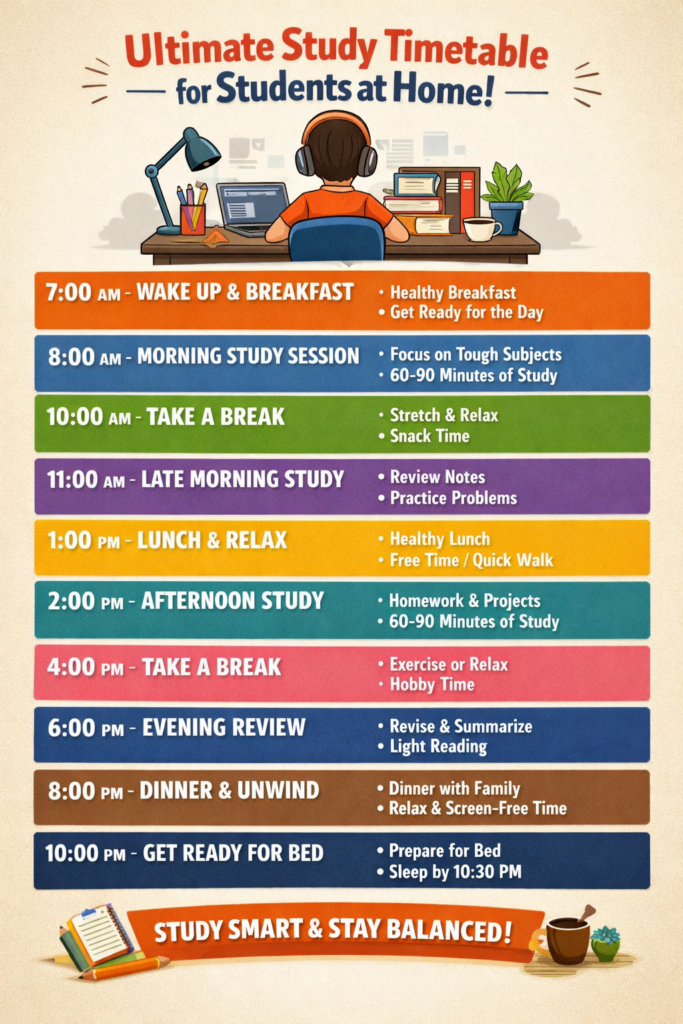
Study Timetable for Class 10 Students (Sample)
Morning
- 6:00–7:00: Revision / Reading
- School hours
Afternoon
- 4:30–6:00: Core subject (Maths / Science)
Evening
- 7:00–8:00: Language or Social Studies
- 9:30: Light revision + sleep
Focus: Consistency over long hours
Study Timetable for Class 12 Students
Daily Schedule
- Morning: Concept-heavy subjects
- Afternoon: Practice problems
- Evening: Revision
Weekly Schedule
- Weekdays: Board syllabus
- Weekends: Competitive exam prep (if applicable)
Daily Study Time Table Options (Based on Capacity)
10-Hour Study Timetable
- Best for board exams with coaching support
- Includes adequate breaks and sleep
12-Hour Study Timetable
- Suitable for competitive exams
- Requires strong discipline and nutrition
15–18 Hour Timetables (Reality Check)
- Not sustainable long-term
- Used only for short exam windows, not daily routine
Productivity ≠ hours studied
Productivity = quality + consistency
Psychology behind an effective study schedule
Pomodoro Technique
The Pomodoro Technique improves focus by breaking study time into 25-minute focused sessions followed by short breaks. This prevents mental fatigue, improves concentration, and helps students stay productive for longer periods without feeling overwhelmed.
Spaced Repetition
Spaced repetition helps improve memory by revisiting topics at planned intervals instead of cramming. Reviewing concepts over days or weeks strengthens long-term retention, making it ideal for exams and subjects that require memorization.
Circadian Rhythm
The circadian rhythm is the body’s natural clock that controls alertness and energy levels. Studying difficult subjects during peak alert hours usually morning or early evening, improves understanding and learning efficiency.
Types of Study Timetables
- Weekly Timetable – Long-term planning
- Subject-Specific Timetable – Weak-area focus
- Revision Timetable – Exam preparation
- Technique-Based Timetable – Pomodoro, active recall
Common Mistakes Students Make
- Overloading the schedule
- Ignoring breaks and sleep
- Studying only favorite subjects
- Never revising or solving past papers
A timetable should protect health, not damage it.
Tools and Apps for Study Timetables
- Google Calendar
- Notion
- Forest App (effective when combined with screen time minimizing plan)
- Physical planners (still very effective)
Conclusion
A study timetable is not about studying more, it’s about studying smarter.
When designed realistically and followed consistently, it:
- Improves academic performance
- Reduces stress
- Builds lifelong discipline
Start small. Stay consistent. Adjust when needed. That’s how real progress happens.
Frequently Asked Questions
This depends on age and syllabus, but most students benefit from 2–5 focused hours daily.
Morning study helps retention; night study works better for revision. The best time is when focus is highest.
Yes. Daily study prevents last-minute stress and improves long-term memory.
Absolutely. A clear schedule removes uncertainty and builds confidence.