


Rote Learning: Meaning, Examples, Techniques & Its Impact on Memory

By The Harvee School
Rote learning is one of the most widely used yet misunderstood learning methods in modern education.
Some consider it to be an outdated learning method. Others see it as foundational. The truth lies somewhere in between.
If you’re researching about rote learning or rote memorization techniques, this guide actually explains exactly:
- What rote learning really means
- How it works inside the brain
- When it is effective
- Where it fails
- How to upgrade it for long-term retention
- And how it compares to conceptual and active learning methods
This is not a surface-level explanation. It is a structured, evidence-aligned breakdown.
What is rote learning?
Rote learning is a memorization method based on repetition, often without deep understanding of the underlying concepts.
It involves repeatedly reviewing or rehearsing information until it can be recalled exactly as learned.
Key characteristics of rote learning:
- Emphasis on repetition
- Focus on exact recall
- Minimal analytical processing
- Often used for factual information
Rote learning prioritizes memorization over comprehension.
What is rote memorization?
Rote memorization is the process of committing information to memory through repeated exposure or rehearsal.
It strengthens recall accuracy through:
- Verbal repetition
- Written repetition
- Drill practice
- Pattern-based rehearsal
Rote memorization is particularly common in early education and exam-oriented systems.
What is rote memory?
Rote memory refers to the ability to recall information exactly as it was learned, often word-for-word.
Examples include:
- Reciting multiplication tables
- Repeating historical dates
- Quoting a poem verbatim
- Memorizing formulas
Rote memory is recall-based, not reasoning-based.
How rote learning works in the brain?
To understand its impact, we need to understand memory formation.
Memory formation involves three stages:
- Encoding
- Storage
- Retrieval
Rote learning primarily strengthens encoding through repetition.
Repeated exposure activates the same neural pathways multiple times. This repetition strengthens synaptic connections, making recall easier.
However, repetition alone does not guarantee deep consolidation.
Long-term retention requires:
- Emotional engagement
- Contextual understanding
- Sleep-based consolidation
- Retrieval practice
Without these elements, rote memory often remains short-term.
Rote Learning Examples in Education
Rote learning appears across multiple subjects.
Common rote learning examples include:
- Memorizing multiplication tables
- Learning spelling words
- Reciting grammar rules
- Memorizing chemical symbols
- Learning historical dates
- Repeating definitions

In early education, rote methods help build foundational recall speed.
However, in higher-level learning, application becomes more important than repetition.
Rote Memorization Techniques
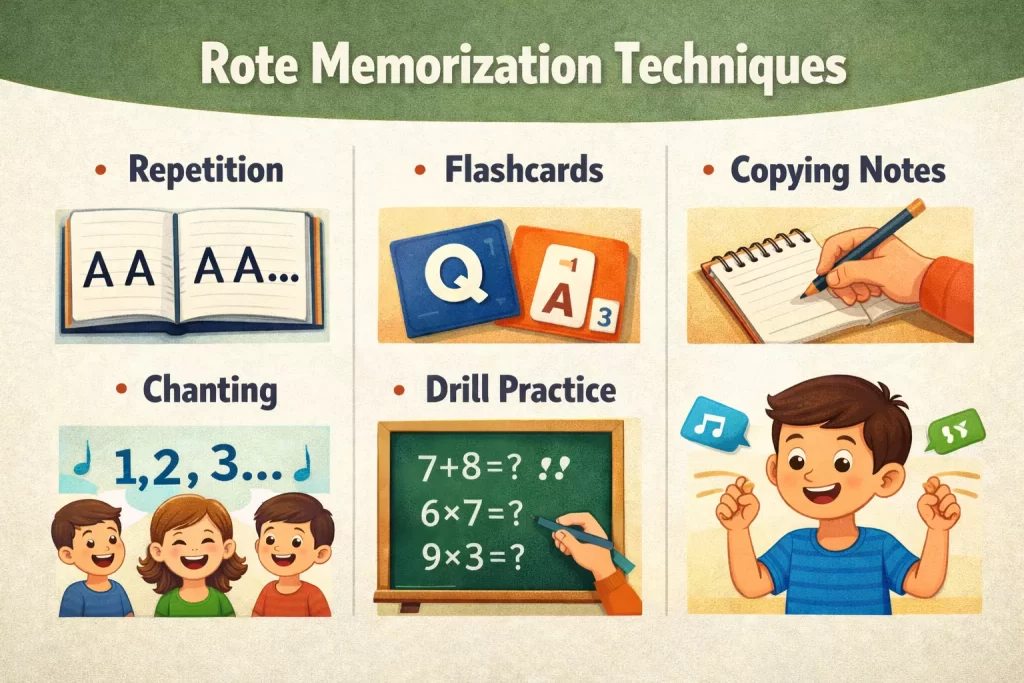
Here are commonly used rote memorization techniques:
1. Repetition
Reading or saying information multiple times.
2. Flashcards
Repeatedly reviewing question-and-answer cards.
3. Copying Notes
Writing the same information repeatedly to reinforce encoding.
4. Drill Practice
Solving similar problems repeatedly.
5. Chanting or Rhythmic Recitation
Used frequently for tables or language learning.
These methods strengthen recall familiarity but may not enhance deep understanding.
When is rote learning effective?
Rote learning is not inherently ineffective. It works best in specific contexts.
It is effective for:
- Multiplication tables
- Vocabulary acquisition
- Chemical formulas
- Alphabet recognition
- Basic grammar rules
- Emergency procedures
In these cases, fast recall is necessary before higher-order thinking can occur.
Foundational knowledge often requires memorization before application becomes possible.
Limitations of Rote Learning
Relying exclusively on rote memorization creates several problems:
- Shallow understanding
- Poor knowledge transfer
- Weak critical thinking
- High exam stress
- Rapid forgetting after exams
Students may perform well in recall-based tests but struggle in analytical or application-based questions.
This is because repetition strengthens familiarity, not necessarily comprehension.
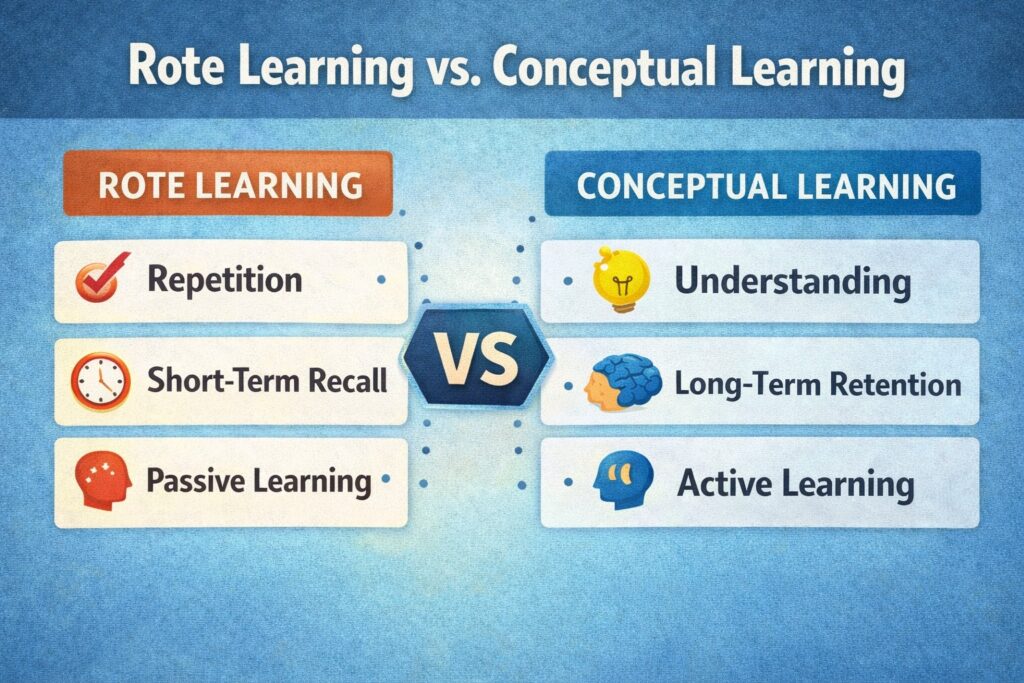
Rote Learning vs Conceptual Learning
Understanding the distinction is critical.
| Rote Learning | Conceptual Learning |
| Based on repetition | Based on understanding |
| Focuses on recall | Focuses on reasoning |
| Short-term retention | Long-term retention |
| Passive rehearsal | Active engagement |
| Fact-oriented | Application-oriented |
Conceptual learning encourages students to connect ideas, solve problems, and apply knowledge in new contexts.
Cognitive science consistently shows that deeper processing improves long-term retention.
Rote Learning vs Active Recall vs Spaced Repetition
To build topical authority, we must distinguish these clearly.
| Method | Core Principle | Long-Term Retention | Cognitive Engagement |
| Rote Learning | Repetition | Moderate | Low |
| Active Recall | Retrieval without prompts | High | High |
| Spaced Repetition | Timed interval review | Very High | Moderate |
| Conceptual Learning | Understanding relationships | High | High |
Rote learning becomes significantly more effective when combined with active recall and spacing strategies.
Common Mistakes in Rote Memorization
Many students misuse rote methods.
Frequent mistakes include:
- Cramming the night before exams
- Passive re-reading instead of testing
- Memorizing without understanding basic meaning
- Ignoring sleep
- Multitasking during repetition
These habits reduce consolidation and increase forgetting.
How to upgrade rote learning for long-term retention?
Instead of eliminating rote learning, upgrade it. Here is a structured improvement framework:
Step 1: Understand Before Memorizing
Even basic conceptual clarity improves encoding depth.
Step 2: Use Spaced Repetition
Review information at increasing intervals.
Step 3: Add Active Recall
Close your book and test yourself.
Step 4: Apply the Information
Solve problems or use the concept in context.
Step 5: Teach Someone Else
Explaining strengthens neural integration.
This hybrid model improves both recall and understanding.
Is rote learning bad for students?
Rote learning is not harmful when used appropriately.
It becomes limiting when:
- It replaces conceptual teaching
- It dominates the curriculum
- Students are evaluated only on memorization
Balanced learning systems combine:
- Foundational memorization
- Structured retrieval practice
- Conceptual reasoning
- Critical thinking development
This approach supports both exam performance and long-term competence.
The role of schools in moving beyond pure memorization
Educational systems focused solely on repetition often prioritize syllabus completion over cognitive development.
However, modern learning science emphasizes:
- Structured retrieval systems
- Concept mapping
- Interdisciplinary thinking
- Problem-based learning
Students benefit most when memory-building techniques are integrated with understanding-driven instruction.
At Harvee School, learning frameworks are designed to combine memory strengthening with conceptual clarity — ensuring students not only remember information but also apply it confidently.
Conclusion
Rote learning remains a foundational educational tool. It builds recall speed and memorizes essential information.
However, repetition alone is insufficient for deep academic growth.
The most effective learning systems integrate:
- Rote memorization for foundational facts
- Active recall for memory strengthening
- Spaced repetition for retention
- Conceptual engagement for application
Education should not end at remembering. It should empower students to understand, apply, and think independently.