

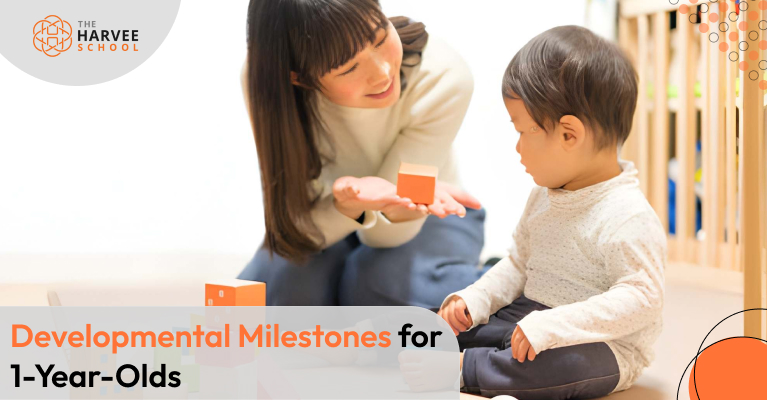
Developmental Milestones for 1-Year-Olds

By The Harvee School
Turning one is a big milestone, not just for your kid, but for parents too.
At this stage, children grow rapidly across physical, cognitive, language, and social domains. Many parents wonder: Is my child developing normally?
Let me guide you what typically happens around 12 months, what variations are normal, and how you can support your child’s growth with confidence.
Development at One Year
Every child develops at their own pace. Developmental milestones are not strict deadlines but general indicators of progress. Some children may achieve certain skills earlier, while others take a little more time and both can be perfectly healthy.
At one year, most children are transitioning from being babies to toddlers. Curiosity increases, independence begins to emerge, and learning happens rapidly through movement, play, and interaction.
Physical and Motor Development Milestones
By 12 months, many children show noticeable improvement in movement and coordination.
Common physical milestones include:
- Pulling to stand and cruising along furniture
- Taking a few independent steps or beginning to walk
- Sitting without support
- Picking up small objects using the thumb and forefinger (pincer grasp)
- Feeding themselves finger foods
How parents can support:
- Provide safe floor space for movement
- Encourage walking with push toys
- Offer age-appropriate finger foods to build hand strength
Cognitive Development Milestones
Cognitive skills relate to how children think, explore, and understand the world.
At this age, children often:
- Recognize familiar people and objects
- Understand simple cause-and-effect (pressing buttons, dropping objects)
- Imitate actions such as clapping or waving
- Explore objects by shaking, banging, or stacking
How parents can support:
- Offer simple problem-solving toys (stacking cups, shape sorters)
- Talk through daily activities to build understanding
- Allow safe exploration rather than restricting movement excessively
Language and Communication Milestones
Language development at one year is often more about understanding than speaking.
Typical milestones include:
- Saying 1–3 meaningful words (like “mama” or “dada”)
- Responding to their name
- Understanding simple instructions such as “come here” or “give me”
- Using gestures like pointing, waving, or shaking the head
How parents can support:
- Talk frequently using clear, simple words
- Read picture books together daily
- Respond positively to babbling and attempts to communicate
Social and Emotional Development Milestones
At one year, children become more socially aware and emotionally expressive.
You may notice your child:
- Showing preference for familiar caregivers
- Experiencing separation anxiety
- Expressing emotions like joy, frustration, or fear
- Engaging in simple interactive games like peek-a-boo
How you can support:
- Maintain consistent routines to create a sense of security
- Offer comfort during moments of distress
- Encourage gentle social interaction with other children
Self-Help and Independence Skills
Early independence starts to develop around this age.
Common signs include:
- Holding a cup with assistance
- Attempting to use a spoon
- Cooperating during dressing (pushing arms through sleeves)
Encouraging these skills helps build confidence and self-esteem.
What’s Normal vs When to Worry (Quick Guide)
| Area | Usually Normal at 1 Year | Consider Checking With a Doctor |
| Movement | Not walking yet, but pulling to stand | Not crawling, standing, or bearing weight |
| Speech | Only babbling or 1–2 words | No sounds, no response to name |
| Social | Clingy, separation anxiety | Avoids eye contact, no interest in people |
| Play | Drops, bangs, explores objects | No curiosity or play engagement |
This table is meant to reassure parents while highlighting when early evaluation may be helpful.
When should parents be concerned?
While variation is normal, consider consulting a pediatrician if your 1-year-old:
- is not crawling or attempting to stand
- does not respond to sounds or their name
- shows little interest in interaction or eye contact
- does not use gestures like pointing or waving
Early evaluation can help identify areas where support may be beneficial.
Supporting Development at Home
Simple daily activities can significantly boost development:
- Talk, sing, and read regularly
- Encourage play that involves movement and exploration
- Limit screen exposure and prioritize real-world interaction
- Provide a nurturing, responsive environment
Final Thoughts
Watching your child reach developmental milestones is exciting but it can also raise questions and worries.
Remember, milestones are guides, not comparisons. Focus on your child’s overall progress, celebrate small achievements, and seek professional guidance if concerns arise.
A supportive, stimulating, and loving environment is the strongest foundation you can provide at this stage of growth.
Frequently Asked Questions
Yes. Many children walk anytime between 9–18 months. Pulling to stand and cruising are positive signs.
Some children say a few words, while others communicate mainly through gestures. Understanding language is more important at this stage.
Limited screen exposure is recommended. Real-world interaction supports better language and social development.
Soft home foods like dal, mashed vegetables, rice, curd, fruits, and well-cooked eggs support healthy growth.
If multiple milestones are delayed or you feel something isn’t right, trust your instincts and seek guidance.